Why are solo cruises so expensive?

So you want to cruise solo...
You check cruise prices, you find a good price "per person", but when you go to checkout as a solo passenger, the price nearly doubles 🤢! This price jump is due to the "single supplement" or "double occupancy" rate.
These extra fees are annoying, but the good news is this article teaches how to avoid these costly fees when booking a solo cruise.
Understanding single supplement and double occupancy
Cruise fares are typically advertised "per person" for two people sharing a cabin (room).
- Double occupancy is when a room or cabin price is based on two people sharing it.
- total cost = cost of 2 people minus port fees for the second person
- Single supplement is the extra fee a solo traveler pays to stay in that room alone.
- total cost = 1 person * a certain percentage
For simplicity's sake, this article will conflate single supplement and double occupancy.
An example of double occupancy:
- The total price of a 12-day Carribean sailing is advertised at $979 per person.
- When attempting to book the sailing, 2 guests are automatically selected for the booking.
- Changing 2 guests to 1 guest results in the booking price nearly doubling to $1,858!
- The solo price was $100 less than double the per-person price because of port fees (per person) of this sailing being $100. Solo cruisers typically only pay the fare of a second person in the same cabin, not the port fees of a second person while cruising solo.
If a cabin can hold two people, the cruise line will do anything they can to get the "full" price of the cabin to maximize revenue.
A price-over-time comparison of an inside room occupied by a solo guest vs. two guests for another sailing:
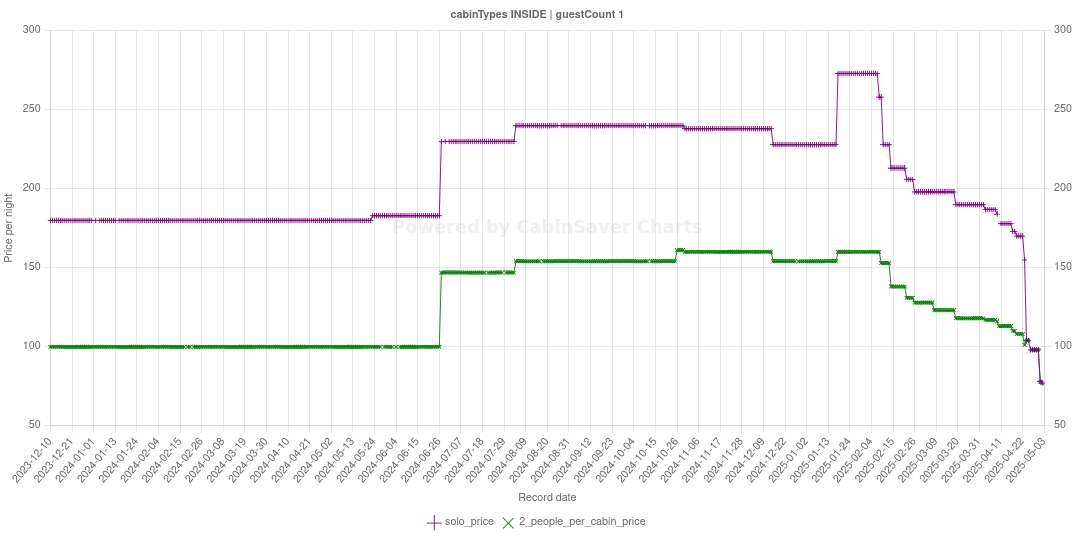
Notice how the last minute double-occupancy price went away for solo travelers about a week before sailing? This last-minute strategy is explained in detail in how to cruise for less as a solo traveler.
Not just cruises
Before abandoning solo cruising and thinking that solo land travel is better with a hotel, be aware that hotels work a similar way.
An example of booking a hotel alone vs. with a friend:
- A hotel room is priced at $100 a night.
- Option 1: you book the hotel room alone and pay $100 a night.
- Option 2: you book the hotel room with a friend - splitting the cost equally - resulting in $50 a night per person.
Traveling alone can get expensive! An alternative that frugal solo travelers can consider is hostels (shared dormitory-style rooms with bunk beds).
Unforunately, cruises don't offer hostel-style lodging (yet?). Assuming regulations (maritime safety, fire codes, etc.) can be appeased and hostel-style cruising appears beneficial to profits, there may be opportunity for reduced fares with hostel-style cruising. Until then, you're at the mercy of the cruise line's double occupancy.
Price fluctuations
Aside from solo supplement fees, a main factor determining solo cruise prices relates to supply and demand. Keep in mind the following when planning your solo cruise:
- Sailing time of year.
- Peak seasons for travel typically occur when people have overlapping vacation time with their family and friends. For example:
- Christmas to New Years.
- Summer time when children are out of school going on cruises with their family.
- Spring break when college kids are off school and want to get wild.
- "Hurricane season" is huge and may reduce demand for cruising during these times.
- Highly influences last minute cancelations, resulting in lower prices.
- Peak seasons for travel typically occur when people have overlapping vacation time with their family and friends. For example:
- Economic factors:
- If the economy is doing poorly, cruise sales likely are doing performing as well.
- Popular destinations:
- Destinations like Hawaii is a dream destination for many people.
Conclusion
Several factors determine the price of a cruise, and cruising solo is one of them. As a general rule of thumb, when hunting for cruise deals, aim for a base fare below $100 a day.
Strategies exist to get great cruise deals such as booking solo cabins, last-minute, and repositioning cruises; CabinSaver describes these strategies in depth in how to cruise for less as a solo traveler. See our 2025 sailing report for data on how pricing trends have played out historically.
Regardless of the strategy you use to get your ideal cruise price, you can find all of the best cruise deals updated daily at CabinSaver's current cruise deals.
Frequently Asked Questions
What is the single supplement on a cruise?
The single supplement is an extra fee solo travelers pay to occupy a cabin alone. Because cruise fares are priced assuming two people share a cabin (double occupancy), a solo traveler effectively pays for both guests. This can nearly double the advertised per-person price.
What is double occupancy on a cruise?
Double occupancy means cruise fares are calculated based on two people sharing a cabin. The advertised "per person" price assumes a travel partner. Solo travelers who book the same cabin alone typically pay the equivalent of two fares, minus the second passenger's port fees.
Why do solo cruisers pay more than couples?
Solo cruisers pay more because cruise lines price cabins for two occupants. A cabin that generates revenue from two passengers at a "per person" rate must still cover its full cost when booked by one person. To maintain revenue, cruise lines charge solo travelers a single supplement that typically adds 50–100% to the advertised per-person fare.
When do cruise lines waive the solo supplement?
Cruise lines sometimes reduce or waive the solo supplement when a sailing has many unsold cabins—typically in the last 1 to 30 days before departure. High supply and low demand incentivizes cruise lines to accept reduced revenue from solo travelers rather than sail with empty cabins.
Do all cruise lines charge a solo supplement?
Most major cruise lines charge a solo supplement, though the amount varies. Some lines like Norwegian Cruise Line offer dedicated studio cabins priced specifically for solo travelers with no supplement. Outside of studio cabins, the single supplement often results in solo travelers paying approximately 150–200% of the standard per-person fare.